About Ochsner
Ochsner Health is a system that delivers health to the people of Louisiana, Mississippi and the Gulf South with a mission to Serve, Heal, Lead, Educate and Innovate.
Welcome to the Emergency Medicine Residency Program! Our dynamic program offers residents superb, state-of-the-art training at one of the largest private academic medical centers in the South. The Ochsner Emergency Medicine Residency Program is committed to providing an exceptional educational experience that will prepare residents to deliver comprehensive, compassionate, and cost-effective care. The Emergency Medicine Residency Program is a fully accredited 3-year program by ACGME and supports Ochsner’s mission to serve, heal, lead, educate, and innovate.
The residency program is a major focus of effort for our faculty and is closely integrated with our quality clinical mission. The current structure and organization of the training program was designed to teach residents to deliver excellent patient care in a supportive and collegial educational environment. The program endeavors to train compassionate professionals who have a comprehensive medical knowledge base of the specialty, can translate that knowledge into effective patient care, and communicate effectively with patients, their families, and the healthcare team. We hope to train “lifelong learners” who will continually strive to improve their own practice, and who effectively use system resources for the benefit of their patients. The ACGME has termed these goals the “Competencies” of Patient Care and Procedural Skills, Medical Knowledge, Practice-Based Learning and Improvement, Interpersonal and Communication Skills, Professionalism, and Systems-Based Practice. An effort will be made not only to teach, but also evaluate these competencies using multiple methods.
The Ochsner Emergency Medicine Residency Program combines the educational resources and clinical complexity of a major academic medical center with the close relationships, responsiveness and community feel of a smaller program.
Our 36-month curriculum is designed to meet ACGME Emergency Medicine requirements while providing residents with broad exposure to academic, community, pediatric, critical care and subspecialty emergency medicine. Residents train throughout the Ochsner system and encounter diverse patient populations, clinical environments and models of emergency care.
The program offers a flexible elective format that allows elective time to be moved into the second year when appropriate. This flexibility helps residents pursue fellowship interests, scholarly work, national leadership opportunities and individualized career goals. The program offers robust support for residents presenting scholarly work at national conferences, serving in national leadership roles and fulfilling military obligations while continuing their medical training.
The Program Director meets regularly with residents to discuss their progress, professional interests and individual development. The Clinical Competency Committee convenes quarterly to review resident performance, after which individualized development plans are created and discussed with each resident and faculty mentor.
The Program Director and Senior Education Program Manager work collaboratively with residency leadership to develop the annual rotation schedule. Rotations are purposefully arranged to support educational progression, resident wellness and an appropriate balance of intensive clinical experiences.
For example, the MICU and Neurocritical Care experiences are divided into two-week blocks rather than scheduled as one consecutive month. Intensive rotations are not scheduled back-to-back, and General Purpose Time and vacation requests are carefully considered during the scheduling process.
Pediatric Emergency Medicine is longitudinally integrated throughout the EM2 and EM3 years so residents continually build and maintain confidence in caring for pediatric patients.
During the EM3 year, every resident completes a four-week external rotation at Grady Memorial Hospital in Atlanta through Emory University.
Learning within another major academic and urban clinical environment exposes residents to a different patient population, healthcare system, institutional culture and approach to emergency care. Emergency physicians may ultimately practice in many different settings, and this experience helps residents become adaptable clinicians who can learn from multiple systems and apply those lessons wherever their careers take them.
Ochsner provides an apartment for each resident during the rotation and reimburses mileage for travel to and from Atlanta.
Ochsner Medical Center provides residents with experience caring for medically complex and critically ill patients, including patients with cancer, sickle cell disease and multiple chronic conditions.
Residents also train at community Emergency Departments throughout the Ochsner system. This combination of academic and community training prepares residents to care for patients across a wide range of clinical environments.
At the EM3 level, residents participate in dedicated intake shifts focused on evaluating and managing lower-acuity emergencies. These shifts complement their high-acuity academic and external clinical experiences and help prepare residents for the full spectrum of Emergency Medicine practice.
Residents are active stakeholders in the continued development of the program.
Quarterly Resident Forums are held during didactic conference and are led by the Chief Residents. Residents discuss their clinical, educational and wellness experiences and identify opportunities for improvement. This feedback is presented to residency leadership and used to develop actionable changes.
All residents also participate in the Annual Program Evaluation Workshop. During this workshop, residents evaluate the program, curriculum and individual rotation experiences from the preceding academic year. Feedback is reviewed with program leadership and shared with the appropriate experience directors so meaningful improvements can be implemented.
The Annual Program Evaluation Workshop is paired with the residency’s annual retreat and includes intentionally protected time for residents and faculty to connect outside the clinical environment. Program traditions have included a resident and faculty ramen dinner and a New Orleans crawfish boil.
This combination of resident-driven improvement and purposeful community-building allows Ochsner Emergency Medicine to offer the educational opportunities of an academic medical center while maintaining a supportive, close-knit program culture.
Residents receive five hours of protected didactic education each week. Conference is designed to be interactive, clinically relevant and responsive to residents at each level of training.
Educational content is tailored to the progression of each residency class while also bringing all three classes together for shared learning, discussion and professional development.
The T3 Series is held on the third Tuesday of each month and focuses on subspecialties and career opportunities within Emergency Medicine.
Sessions introduce residents to fellowship-trained physicians and fields such as Medical Education, Sports Medicine, Hyperbaric Medicine, Palliative Care, Pain Medicine, Toxicology, Ultrasound, Emergency Medical Services and other areas of focused practice. The series helps residents explore career paths, identify mentors and understand how subspecialty training can be incorporated into a career in Emergency Medicine.
Program Director Hour provides protected time for residents to meet directly with the Program Director. This time may be used to discuss resident development, program updates, professional issues, career planning, wellness, concerns affecting the resident experience and opportunities for program improvement.
Journal Club is incorporated into the didactic conference curriculum and teaches residents how to critically evaluate medical literature. Residents analyze study design, methodology, statistics, bias, validity and clinical applicability. The goal is not only to review the conclusions of an article but also to understand what makes a medical journal article strong, reliable and useful to clinical practice.
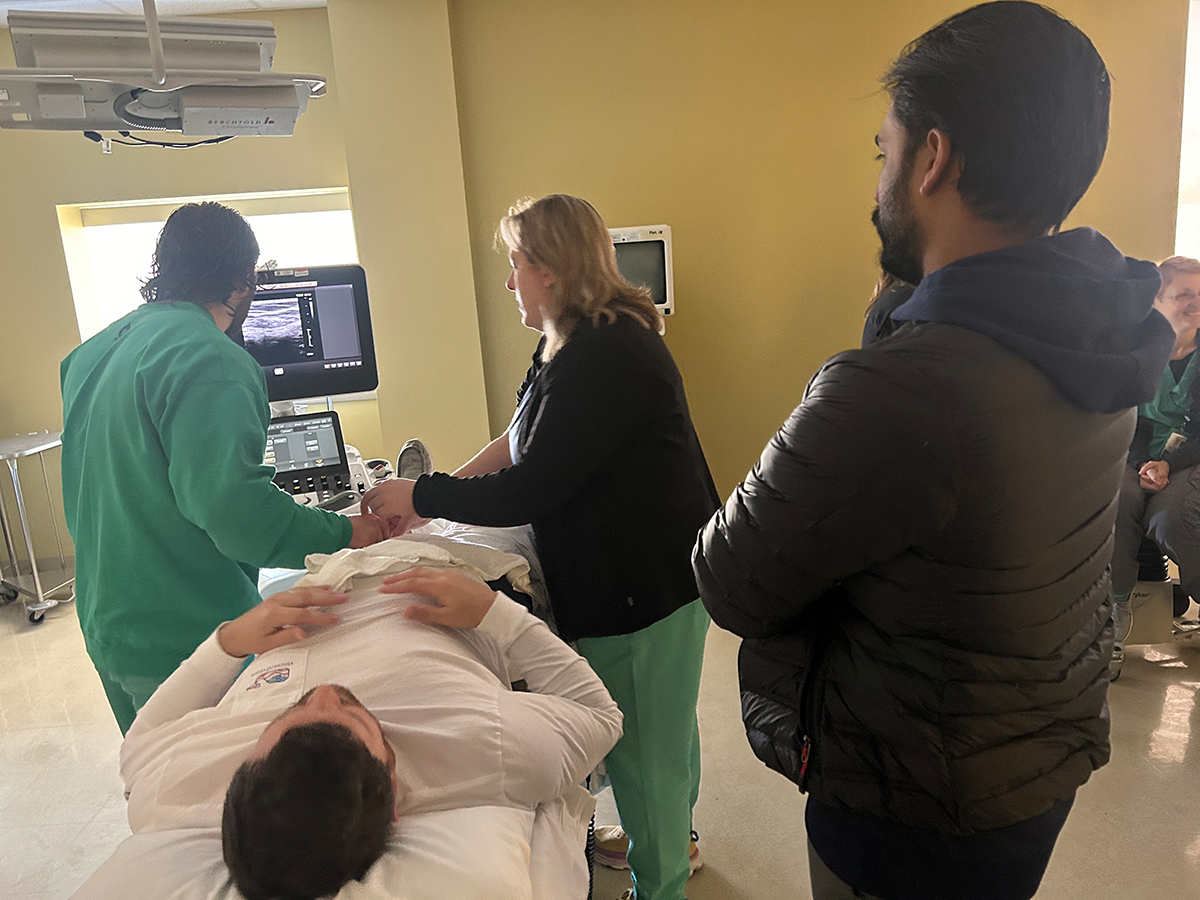
Dedicated Simulation and Ultrasound Days are held monthly as part of the protected didactic curriculum. These sessions provide residents with hands-on experience in resuscitation, procedures, team communication, point-of-care ultrasound and the management of uncommon or high-risk clinical scenarios.
The Emergency Medicine simulation curriculum is led by Nicole Novotny, MD, Director of Emergency Medicine Simulation, in collaboration with Emergency Medicine faculty and the program’s ultrasound leadership.

The Ochsner Clinical Simulation and Patient Safety Centerprovides residents with an advanced environment for immersive, hands-on learning.
Residents participate in simulation-based education beginning during orientation and continuing throughout all three years of residency. The curriculum includes Emergency Medicine-specific resuscitations, procedural training, communication exercises, team-based care and the management of uncommon or high-risk clinical scenarios.
The Emergency Medicine simulation curriculum is led by Nicole Novotny, MD, Director of Emergency Medicine Simulation and a fellowship-trained simulation educator.
Dedicated Simulation and Ultrasound Days are held monthly during protected didactic conference. Simulation concepts and exercises are also incorporated into the longitudinal educational curriculum throughout the academic year.
Research prospects are abundant at Ochsner. Residents in Emergency Medicine are allotted the opportunity to conduct research in any topic within our field. Residents are encouraged to explore subjects that offer them interest and will have a meaningful impact in Emergency Medicine. Residents have the opportunity to present their work in a supportive environment while establishing collaborations and creating academic friendships at Ochsner’s Annual Research Week, held annually in May. This event showcases the biomedical research of investigators within the Ochsner Health while including students of the University of Queensland-Ochsner Clinical School, along with postdoctoral fellows, scientists, clinical residents and fellows, nurses, and pharmacists. It’s a week-long event that includes general assemblies, a noon keynote address, a poster display, and an evening networking session with hor d’oeuvres and cocktails. In addition, residents have the ability to submit their work for publication to the Ochsner Journal, a quarterly medical journal providing a wide range of peer-reviewed, timely, and practical information.
Residents at Ochsner have access to a vast amount of resources to enhance their clinical and educational experiences. The Medical Library is available for use and provides access to over 1,700 electronic journals and over 250 electronic books, all searchable through high-value databases. In addition, Ochsner’s Research Division, Clinical Simulation and Patient Safety Center, along with various Web Applications and External Organizations suggested by Graduate Medical Education can help residents develop their career further.



Ochsner Health is the leading nonprofit healthcare system in the Gulf South, serving patients across Louisiana, Mississippi, and surrounding regions.


